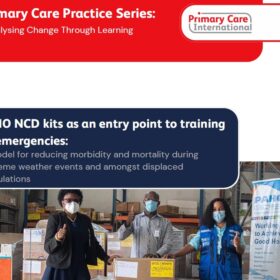
New paper in PCI’s Primary Care Practice series: WHO NCD kits as an entry point to training in emergencies

The third paper in our Primary Care Practice series is out now. Entitled ‘WHO NCD kits as an entry point to training in emergencies’ In this paper, we explore the WHO Non-Communicable Diseases Kit (NCDK) initiative, which aims to enhance the management of patients with NCDs in emergency settings, particularly in regions with displaced populations. … Read more …

Our 2022 Annual Report – out now!

In the wake of an eventful year, we are thrilled to unveil our latest Annual Report, offering insights into our continued journey towards a brighter, healthier future. Welcoming our new CEO, Steve Murigi, and building upon the foundations laid last year, we embark on a new chapter of progress and transformation. Find out some of … Read more …

Transforming Healthcare Education: The Power of Digital Learning for the Health Workforce

Digital technologies have revolutionised various aspects of our lives, including education. Traditional learning models are rapidly changing as digital tools and resources integrate, giving rise to digital learning. This shift has the potential to transform training for the health workforce, empowering professionals to acquire and enhance their skills and knowledge more efficiently. The COVID-19 pandemic … Read more …

We are hiring: Head of Programmes and Business Development

This is an exciting time to be joining PCI: with a refreshed Vision, Mission and Sustainable Impact Principles we are seeking to really grow the PCI Academy – our online home for learning – with a focus on bringing the voices of healthcare workers participating in PCI’s programmes into the centre of our thinking. We’re … Read more …

Access to Quality Healthcare for Cancer: A Fundamental Human Right and Social Justice Issue

In low- and middle-income countries (LMICs), the treatment of cancer is far behind that of  high-income countries (HICs). Inadequate investments in primary healthcare (PHC), the skills gap between cancer care providers in LMICs and their counterparts in HICs are some of the major obstacles to providing quality care for cancer patients in LMICs, along with … Read more …

How are humanitarians using AI tools like Chat GPT?

The use of AI (Artificial Intelligence) is rapidly growing in various industries and fields, including healthcare, finance, manufacturing, transportation, the humanitarian sector and more. AI technology has the ability to automate routine tasks, analyse vast amounts of data, and make predictions or recommendations based on patterns and trends that humans may not detect. As AI … Read more …

Call for Consultants – Project Lead and Content Writers for Clinical Training Materials

Attention all healthcare professionals! PCI is working in partnership with the Primary Health Care Institute (PHCI) of the Libyan Ministry of Health to enhance the capabilities of the primary healthcare workforce in Libya. The goal is to provide high-quality, evidence-based care to the Libyan population. The project is supported by GIZ’s Improving Primary Health Care … Read more …

Meet the CEO, Steve Murigi

1. Can you tell us about your background and how this led you to global health? Growing up in the rural countryside of Kenya in the early 80s was a critically formative period in my life. I was born to a mother who was barely out of high school, and I lived with my grandmother … Read more …

PCI and Red Whale partnership to support primary healthcare systems strengthening

Primary Care International (PCI) and Red Whale are pleased to announce a renewed partnership agreement between the two organisations. Red Whale, a founding sponsor of PCI, is one of the UK’s leading primary care medical education providers and since 2014 has supported the work of PCI as a social enterprise, to strengthen primary healthcare globally. … Read more …

Humanitarian learning delivery: has the pandemic led to lasting change?

COVID-19, non-communicable diseases and poverty represent a global health emergency on a scale which is difficult to comprehend. However, there is a need for innovative solutions, co-created with partners and stakeholders, to address primary healthcare workforce capacity, particularly in low- and middle-income countries (LMICs) where health systems lack resilience and are inadequately equipped to respond … Read more …